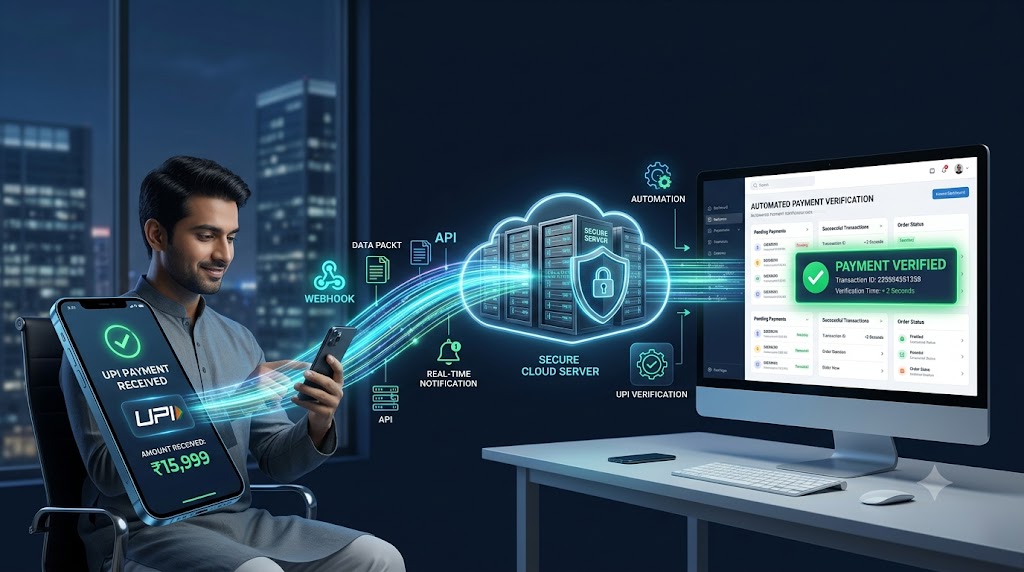
How Webhooks Help Automate UPI Payment Verification
For an online business, receiving a UPI payment is only one part of the process.
The bigger question is:
How does your website or app know that the payment has actually been received?
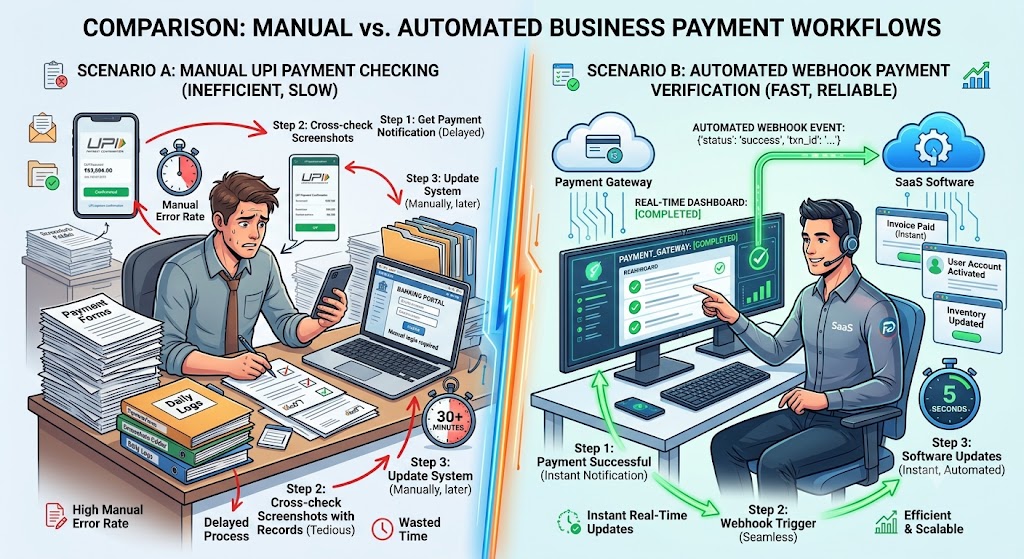
In a manual payment process, a customer may share a payment screenshot and the business team has to check the transaction manually before confirming the order or service.
This process can become slow and difficult when transaction volume increases.
That's where automated UPI payment verification becomes useful.
With webhook technology, payment-related information can be sent directly from the payment infrastructure to your website or application when an event occurs. This allows your software to process payment updates without repeatedly asking the API for the latest status.
In simple words:
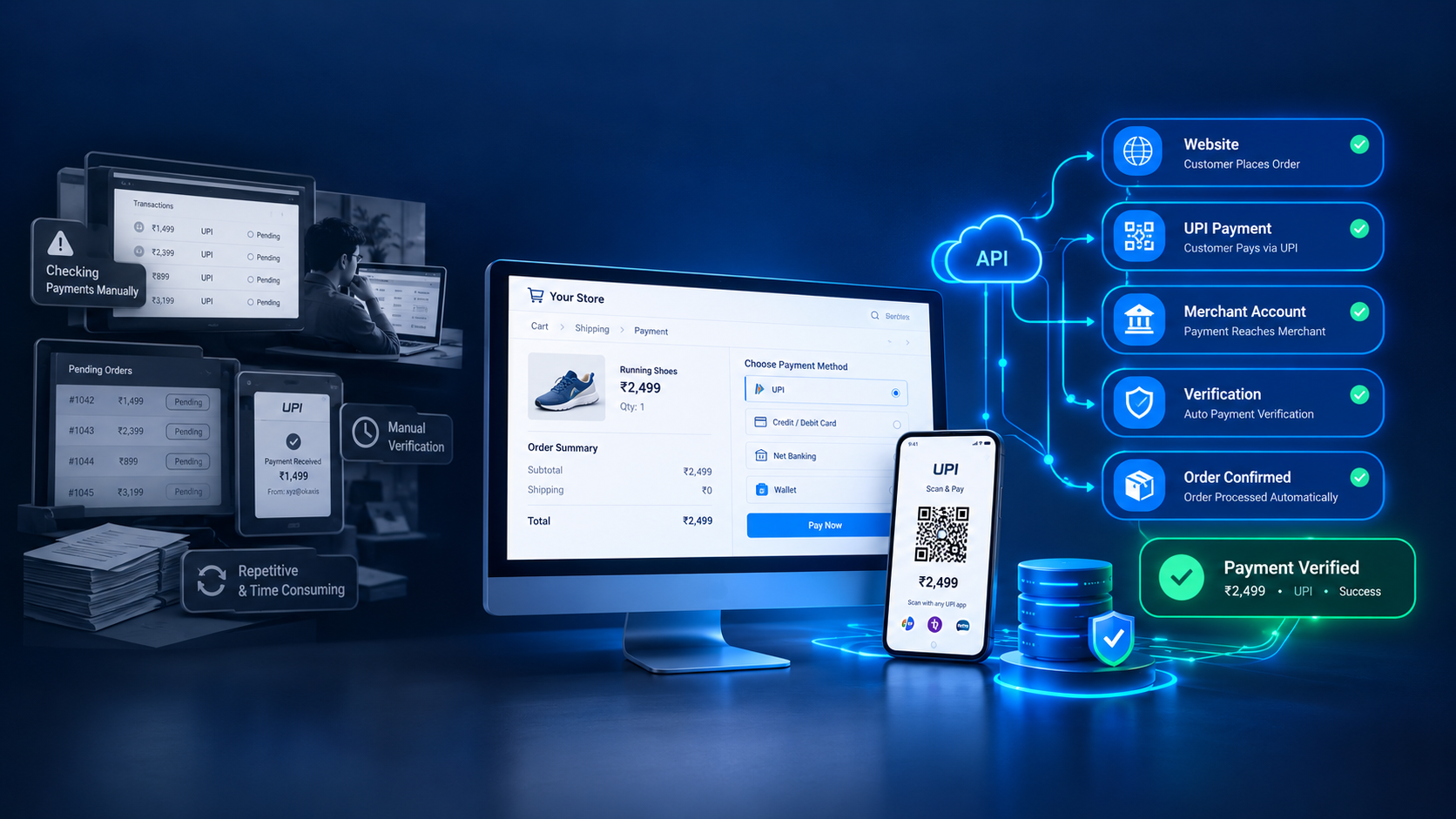
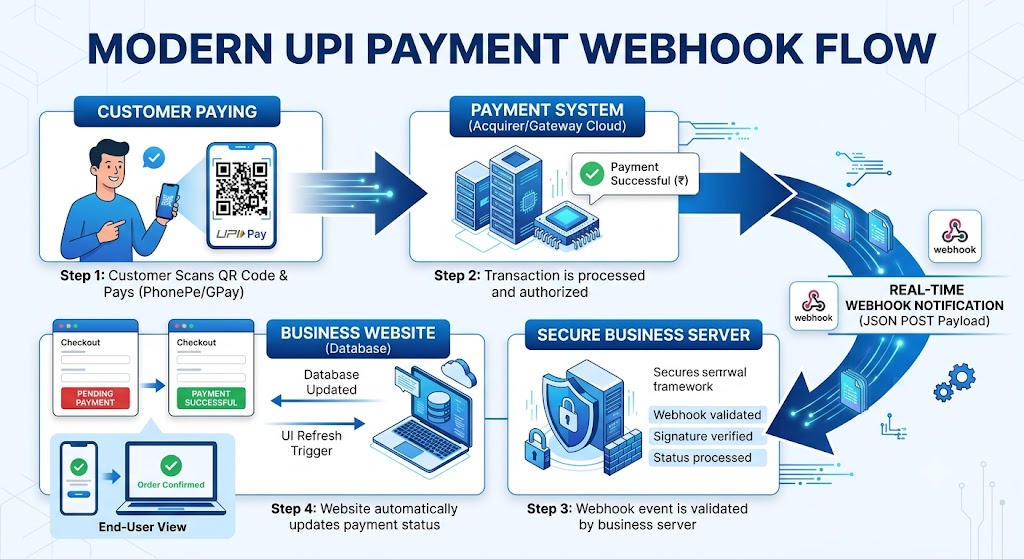
Customer makes payment → payment event occurs → webhook sends information → your system verifies/processes the update → application updates automatically.
This can help businesses reduce manual work and create a faster payment experience.
What Is a Webhook?
A webhook is a way for one system to automatically send information to another system when a particular event happens.
Unlike traditional API polling, where your application repeatedly asks:
“Is there any new payment?”
a webhook works more like:
“When a payment event happens, send the information to my server.”
For example:
Customer Makes UPI Payment
↓
Payment Event Detected
↓
Webhook Triggered
↓
Your Server Receives Data
↓
Payment Status Processed
↓
Website / App Updated
This event-based approach can make payment workflows much more efficient.
Why Is UPI Payment Verification Important?
UPI has become an important payment method for Indian online businesses.
But simply displaying a UPI ID or QR code isn't enough for a fully automated payment workflow.
A business may need to know:
- Whether a payment was received
- Which order the payment belongs to
- The transaction reference
- The payment amount
- The current payment status
- When the payment was processed
Without automation, businesses may depend on screenshots, manual checking, spreadsheets, or customer support teams.
This can create unnecessary work.
For businesses handling many payments every day, automated payment verification can make the overall workflow much smoother.
How UPI Payment Webhooks Work
The basic webhook process is relatively simple.
Step 1: Customer Initiates Payment
A customer chooses UPI as the payment method and completes the payment through their preferred UPI application.
Step 2: Payment Event Is Generated
After the transaction is processed, the payment infrastructure receives information about the transaction.
Step 3: Webhook Is Triggered
The configured webhook endpoint receives the relevant event data.
Step 4: Your Server Receives the Data
Your website or application receives the webhook request and processes the information.
Step 5: Payment Status Is Updated
Your application can update the relevant order, account, subscription, wallet or service status according to your business logic.
The entire process can happen automatically.
Webhooks vs API Polling for Payment Verification
There are two common approaches to receiving payment updates:
Polling and Webhooks.
API Polling
With polling, your application repeatedly sends requests to check whether a payment status has changed.
For example:
Check Payment
↓
Wait
↓
Check Again
↓
Wait
↓
Check Again
If you have many transactions, this can create a large number of API requests.
Webhooks
With webhooks, your application waits for the payment event.
When the event occurs, the information is sent to your configured endpoint.
Payment Event
↓
Webhook
↓
Your Server
↓
Payment Processing
For event-based payment notifications, this can be a much more efficient architecture.
Benefits of Automating UPI Payment Verification
1. Reduces Manual Work
One of the biggest advantages is reducing repetitive payment checking.
Instead of your team checking every transaction manually, your software can receive payment events automatically.
This becomes especially useful when transaction volume grows.
2. Faster Payment Updates
When payment information is delivered through an event-driven system, your application doesn't have to constantly wait for the next polling cycle.
This can help your system process payment updates faster.
3. Better Customer Experience
Imagine a customer completes a payment but their order remains stuck on:
“Payment Pending”
for several minutes.
That isn't a great experience.
An automated verification workflow can help your website or application update payment status more efficiently.
4. Fewer Manual Verification Errors
Manual verification can sometimes result in:
- Wrong transaction matching
- Duplicate entries
- Missed payments
- Incorrect status updates
- Delayed confirmation
Automation can reduce these repetitive human errors when implemented correctly.
5. Better Scalability
A manual payment process may work when you have a small number of transactions.
But as your business grows, the same process becomes harder to manage.
Automation allows the software to handle a larger number of payment events without increasing manual workload at the same rate.
What Information Can a Payment Webhook Send?
Depending on the implementation and provider, webhook payloads can contain transaction-related information such as:
{
"status": "success",
"amount": "999.00",
"transaction_id": "TXN123456",
"order_id": "ORDER789",
"timestamp": "2026-08-19T12:00:00"
}
The exact fields and format depend on the API or infrastructure being used.
Your application can then use this information according to its own business logic.
For example:
Webhook Received
↓
Validate Request
↓
Check Transaction
↓
Match Order ID
↓
Process Payment Status
↓
Update Database
↓
Show Confirmation
Why Webhook Security Matters
A webhook endpoint should not simply accept every incoming request.
Because payment-related information is involved, businesses should implement appropriate security controls.
Some common practices include:
HTTPS
Use HTTPS for secure communication between systems.
Authentication
Use appropriate authentication mechanisms to make sure requests are coming from an authorized source.
Signature Verification
Where supported, webhook signatures can be verified before processing an event.
Duplicate Protection
Your system should be designed to handle duplicate webhook events safely.
Event Logging
Maintaining appropriate logs can make troubleshooting easier when a payment event doesn't process as expected.
What Happens If a Webhook Fails?
A reliable webhook architecture should consider failed deliveries.
For example, your server may temporarily be unavailable when a webhook is sent.
Depending on the provider, webhook systems may support mechanisms such as:
- Retry attempts
- Delivery logs
- Event IDs
- Failure notifications
- Manual reprocessing
Your application should also be idempotent, meaning processing the same event more than once should not accidentally create duplicate actions.
For example, if the same successful payment notification arrives twice, your system shouldn't credit the same order twice.
This is a very important part of building a reliable payment automation system.
How JaduPe Helps With Payment Automation
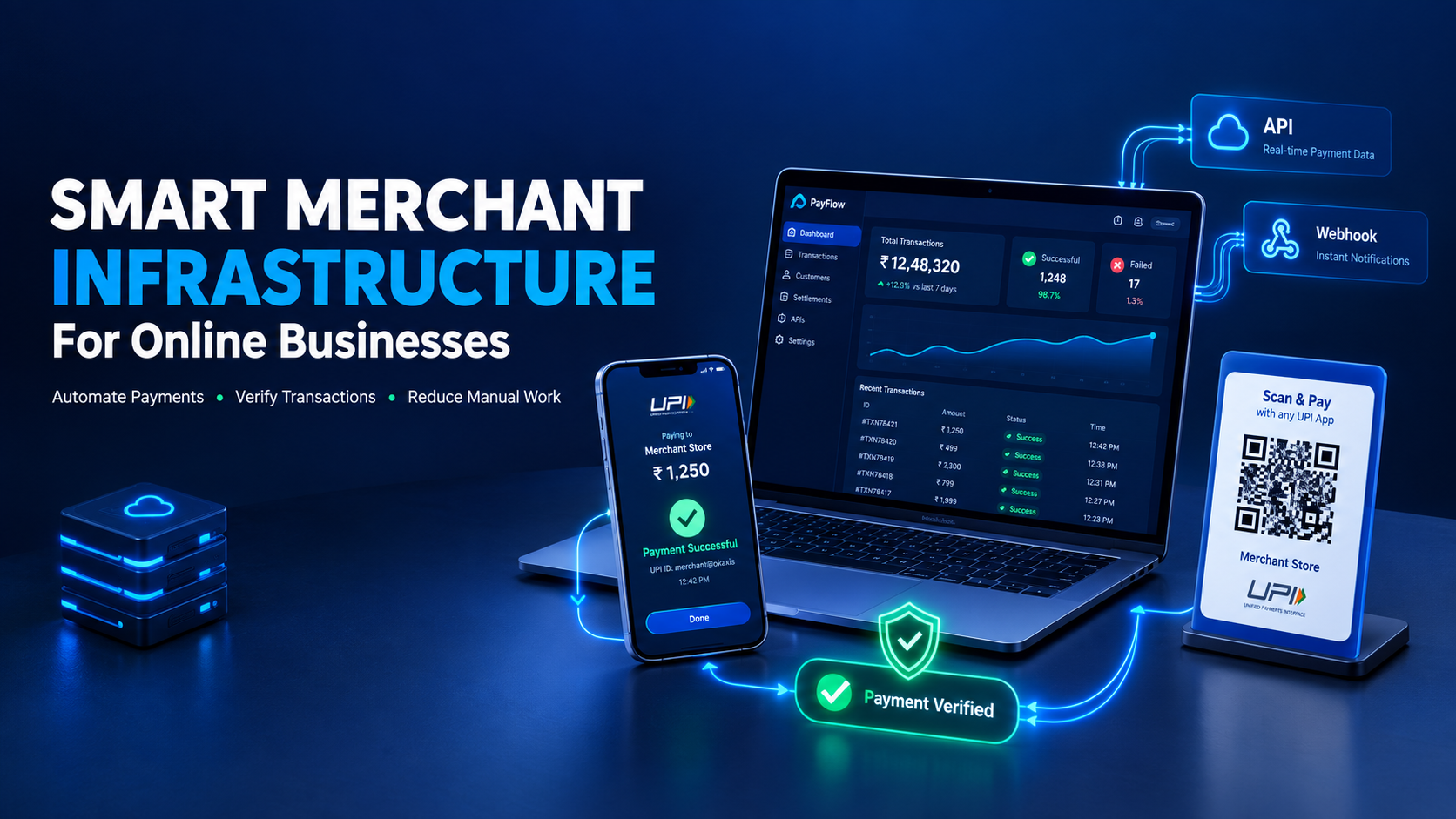
JaduPe is designed around smart merchant infrastructure for online businesses.
Businesses can connect their existing merchant UPI setup with payment automation technology and build a smoother payment workflow for their website or application.
Instead of relying completely on manual payment checking, businesses can use automated technology to receive and process payment-related updates.
JaduPe supports payment automation workflows that can be integrated into online business systems, helping reduce repetitive manual work and improve the overall payment experience.
For businesses building their own website or application, this type of infrastructure can be useful when payment confirmation needs to become part of the software workflow.
UPI Payment Automation for Websites and Apps
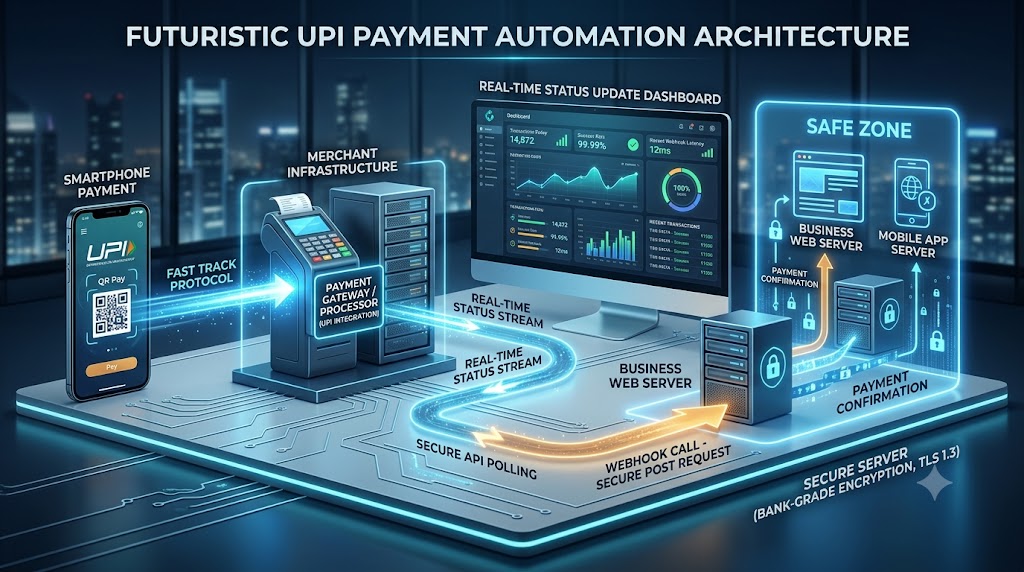
A modern payment workflow can look something like this:
CUSTOMER
↓
UPI PAYMENT
↓
MERCHANT PAYMENT SYSTEM
↓
WEBHOOK
↓
BUSINESS SERVER
↓
PAYMENT VERIFICATION
↓
WEBSITE / MOBILE APP
↓
ORDER / SERVICE UPDATE
This architecture allows payment information to move between systems automatically.
It also gives developers more control over how payment events are handled inside their applications.
Who Can Benefit From UPI Payment Automation?
UPI payment automation can be useful for many types of online businesses, including:
- E-commerce websites
- SaaS platforms
- Subscription businesses
- Digital service providers
- Online marketplaces
- Mobile applications
- Education platforms
- Booking platforms
- Membership websites
- Online service businesses
The exact implementation depends on the business model and the software architecture.
Things to Consider Before Implementing Payment Webhooks
Before integrating a webhook-based payment workflow, developers should consider:
1. API Documentation
The documentation should clearly explain endpoints, authentication, webhook events and response formats.
2. Webhook Reliability
Understand how failed webhook deliveries are handled.
3. Security
Use HTTPS, authentication and appropriate verification mechanisms.
4. Duplicate Events
Make sure your application can safely handle repeated events.
5. Error Handling
Your application should have proper handling for failed or incomplete transactions.
6. Monitoring
Payment systems should be monitored so developers can identify failed events quickly.
Frequently Asked Questions
What is a UPI payment webhook?
A UPI payment webhook is an event-based mechanism that allows payment-related information to be automatically sent to a business server when a relevant payment event occurs.
How does webhook-based payment verification work?
The payment event triggers a webhook request to your configured server. Your application receives the information, validates it, and then updates the relevant payment or order status according to its business logic.
Are webhooks better than polling?
For event-driven payment updates, webhooks can be more efficient because the application doesn't need to repeatedly request the payment status.
Can webhooks be used on websites?
Yes. A website's backend can expose a webhook endpoint that receives payment-related events and updates the database or order status.
Can webhooks work with mobile applications?
Yes. Usually, the webhook is received by the application's backend server, which then communicates the relevant status to the mobile application.
How do webhooks reduce manual payment verification?
Instead of employees manually checking payment information, the software can receive payment events automatically and process them according to predefined rules.
Are payment webhooks secure?
They can be secure when implemented properly using HTTPS, authentication, signature verification where available, validation, logging and duplicate-event protection.
Conclusion
UPI payment verification doesn't have to be a completely manual process.
With webhook-based automation, businesses can connect payment events with their websites and applications and create a more streamlined payment workflow.
Instead of continuously asking an API for updates, the application can receive information when relevant events occur.
This can help businesses:
- Reduce manual work
- Process payment updates faster
- Improve customer experience
- Reduce repetitive API requests
- Scale payment operations more efficiently
For modern online businesses, UPI payment automation + webhooks + reliable merchant infrastructure can be an important part of building a smoother digital payment experience.
If your business already uses a merchant UPI setup and wants to connect payment activity with its website or application, a technology-driven approach like JaduPe can help simplify that workflow.